WHY WAR?
In this tiny but dense work about war written by Frederic Gros, I received some insights on humanity's constant need to wage war, and gleaned a bit more about the nature of war itself.

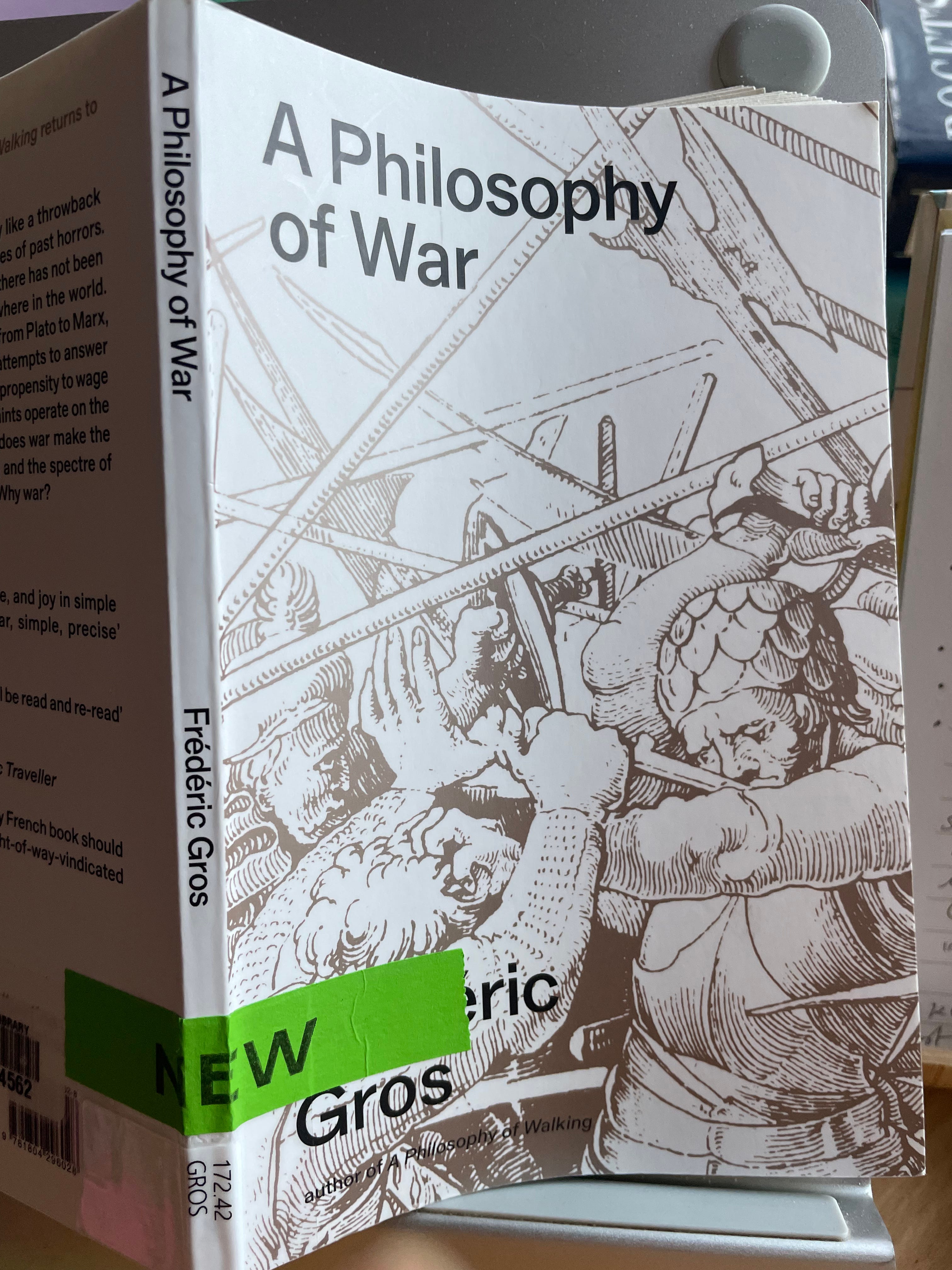
The most recent major war involving Iran began on February 28th but that’s a misconception, says Frédéric Gros in A Philosophy of War: Why We Fight. We’ve always been fighting.
First published as Pourquoi La Guerre? in 2023, its translation by Gregory Elliot from the French was published earlier this year by Verso. This is a collection of six essays, each of which examines an important idea around war. Gros debates what is meant by a “return” to war, heroism and barbarism, when war is just, the idea of total war, why there is a need at all for war, and how the state makes war and war makes the state. This essay collection was clearly prescient when it was written—in the aftermath of the Ukrainian war in March 2022—because we know how much has happened globally since then.
Our tendency, when we talk about a current war, is that we’ve “returned” to war from a previously existing state of peace. Frederic Gros says that it never really ended in the first place for us to have to somehow return to it. Exactly, I thought, while considering the present state of the war at Hormuz. When were we ever out of it in the last many years?
A few decades after Japan’s capitulation, General Claude Le Borgne could write: “war died in Hiroshima”.
Yet this “prohibition” (UN), along with this “impossibility” (nuclear weapons) did not automatically bring about peace on Earth.
There’s another idea that Gros discusses that is so on point. There was a time when war involved two known enemies and a place over which the war was being waged. There were clear winners. That idea does not hold true anymore. The author writes about three sorts of wars: conventional warfare where the two warring states had clear ideological winners with one acquiring territory or some sphere of influence; the global or ‘diffuse’ war in which major armed violence shows up in original acts of terrorism; and then the chaos-creating war, one that is waged for its own sake, not to bring about peace. Of course, I realized, right as I was reading Gros’ description of it, that I was hot in the middle of one, both at home (on any given day) and on the international stage.
As the author delves deeper into the description, he quotes (among many great thinkers), one 15th century Italian statesman below whose words are brilliant.
One day, Giacomo Trivulzio came up with this formula: “To wage war, three things are required: firstly money, secondly money, and thirdly money.”
Does all this sound familiar? While this is indeed true, Gros argues that money does not always guarantee a victor, for the historical counter examples are many. He writes that the war in Vietnam revealed a relentless people who showed “the ethical commitment, the spiritual energy, the desire harnessed in fighting (to attack or defend, to riposte or destroy), the moral quality of the belligerent willpower.”
Frederic Gros’ work is worth one’s time Just be warned that it’s packed with much introspection and so many references that each paragraph sometimes needs to be read again a couple of times. At the end of the reading, I will admit to the fact that I’ve not done justice to these essays. I think this collection will be far more valuable and enjoyable if picked apart with another like-minded reader.
In closing I was a bit disappointed, however, that I did not see any reference in this book to The Mahabharata, one of the two major Sanskrit epics of ancient India, which narrates the events of the Kurukshetra War between two groups of princely cousins. The Mahabharata is a seminal Hindu text about war but it’s above all a philosophical treatise on how to live in the world. Gros quotes many names from the western canon, including Plato, Kant, Hobbes, and Machiavelli, in the chapter on what is a “just” war but it did leave me wondering about the eastern wisdom on the subject.
When one of the two felines engaged in a furious battle for predominance puts an end to it, it is by presenting its neck, or the most vulnerable part of its body, to its opponent: a single stroke of the claws and death is certain. This posture suffices to eliminate aggression in the other. We shall not find any cruel relentlessness, any gratuitous ferocity, in these animal battles. In fact, man alone is truly bestial; animals never are—with hte exception of those thahave been domesticated…Sadistic cruelty is human, all too human.
Sounds interesting, will check out at some point. What I find profoundly depressing is our collective refusal, despite the many resources offering 20/20 hindsight, to learn from history.