LYING—AND DYING—FOR LOVE
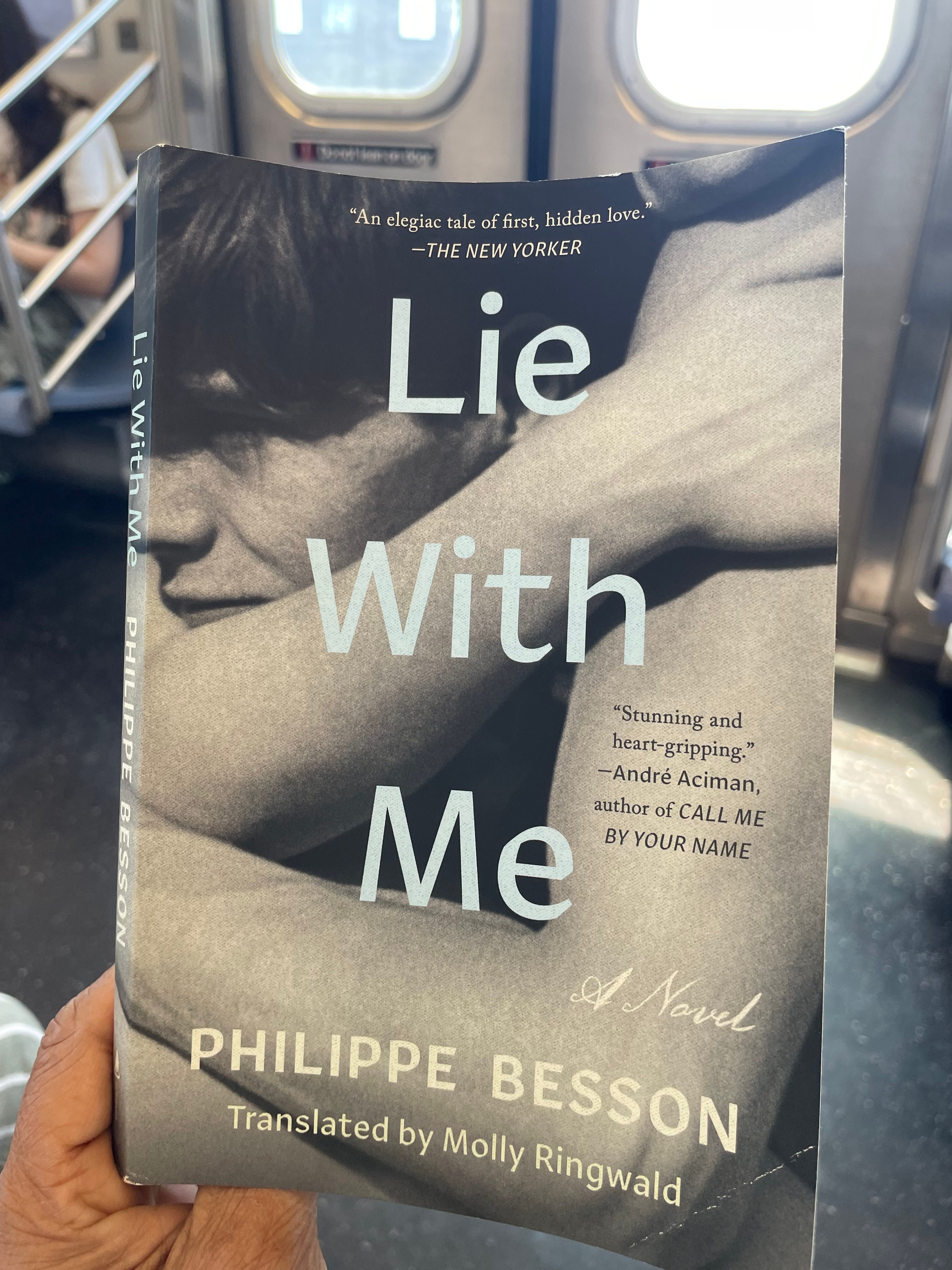
A French novella by Philippe Besson keeps me company on the train rides in Brooklyn. This work about two gay men will likely see you missing your appointment, your flight or your boat. Beware.

During the first ten days of June, I was with my grandson a lot of the time. And what a time it has been! I guess I’ve been reading less ever since the baby was born in Brooklyn last May but I remain utterly guilt-free. Nothing beats this experience of grand-parenting and, at least until all this newness fades, I’m allowing myself the liberty to read less, and write fewer posts.
This week’s pick is a translation from French, a book I could not put down. I bought LIE WITH ME by Philippe Besson for my daughter on my last visit and it seemed like a perfect time to read it while I was visiting her. The book recounts a secret, passionate love affair between two teenage boys in a high school in France in 1984.
The tale begins some forty years after that, however, with the suspense of having spotted someone from the past. The protagonist, one of the two lovers, is at lunch in a train station and he has just seen someone who, judging from his profile and his back, resembles his former lover.
We learn that Philippe is a brilliant student who is part of an accelerated class while Thomas is not. The posting of the result of a baccalaureate exam is the precise moment during which something that Thomas said to him right after their first meeting begins to define their relationship: “Because you will leave and we will stay.” Thomas is the only son of a farming family from Spain and he is expected to uphold what his parents have set up. Philippe, on the other hand, is part of the urban class, the child of an academic, who, apparently, has a choice to exert his will. Thomas’ circumstances do not allow for a freedom of action and expression. (I found this unconvincing while reading this in the present day but I had to tell myself that this was a story about two young men in the eighties at a time when the world was in the throes of the AIDS epidemic.)
In June, we take our baccalaureate. In July, we read a list on the blackboard telling us that we passed. I’m happy, as one is in these moments. Thomas acts like a killjoy. He starts in on me: You never really thought you wouldn’t pass, it’s not like you were shaking in your boots as you looked for your name on the list, right? Even the passing with honors wasn’t a surprise to you. I tell him that knowing it doesn’t prevent happiness, that we can still savor the moment. I did not understand then that the bac was the end of us.
Translated by Molly Ringwald, the story is a coming-of-age tale exploring first love and often compared to Brokeback Mountain. What I loved about this story, beyond the crisp and clean telling of it, was the clarity with which it looked at the lies we tell ourselves. The boys—men, really—have this connection that is inexplicable. One of them accepts it and is willing to embrace it and live in the moment and quite possibly ready to take it forward; the other man, Thomas, decides, the very day he feels the attraction for Philippe, that it’s not going to be possible for him to live thus. He fights this attraction in public and fumes—while making out with Philippe—in private. What I found infinitely engaging about this story was how Thomas accuses Philippe of always planning to leave. All along, it’s Thomas who knows he will have to leave.
As the story closes, the reader is forced to look back on this momentous line about leaving and staying. Philippe leaves for college but well before that Thomas returns home to a life on the farm. Many decades later, Philippe will learn about Thomas’ wedding to a woman with whom he shares a child. A photograph from Thomas’ wedding day is telling.
It’s clear to me that the sadness was unrelated to the demands of an overzealous wedding photographer, but of course I stop myself from saying anything.
I think: if it was already there, this sadness, from the very first hours of the marriage, if it was so massive that it could not be concealed even then, during these moments of the greatest communion, during the happiest of feasts—how heavy must this weight have become in the years that followed?
I don’t wish to disclose much more about this story because it will ruin the experience for the reader. My heart has been in pieces since I read this beautiful tale told with extraordinary sensitivity. LIE WITH ME is a tale for everyone of every stripe and every leaning, one that reminds us that to live, truly live out our lives in the brief time we are assigned, the only way to be is to be true to ourselves, to implicitly trust that the decisions we make with our gut (and not with our heads), will ultimately be the decisions that will make for a fulfilling life.